
Blog · Septic Pumping
“Flushable” wipes and why that label doesn't mean septic-safe
Published February 6, 2025 · Updated September 20, 2026 · By the Atteberry Industries crew, Show Low, AZ
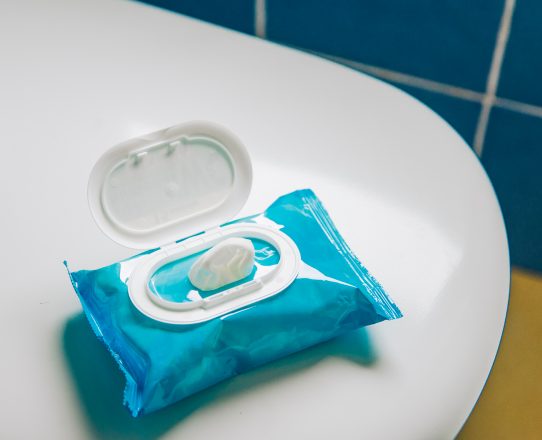
Short answer: "Flushable" wipes are engineered to pass through a toilet, not to break down in a septic tank the way toilet paper does. They hold together in the tank for years, snag on baffles and any root intrusion, and build up into clogs that trigger early pump-outs or line repairs — a bigger deal on a rural system than on municipal sewer, where the label originated.
What does "flushable" actually mean on a package of wipes?
It means the wipe is thin enough to travel through a toilet trap and into the sewer line without immediately jamming the plumbing — nothing more.
Manufacturers test for clearing the toilet, not for breaking down once they reach a septic tank. There's no requirement that the material disintegrate the way single-ply toilet paper does within minutes of contact with water, which is the actual test that matters for a tank system.
Reason 1: wipes don't break down inside the tank
Instead of dissolving, wipes stay intact for months or years, floating and tangling near the outlet baffle where solids are supposed to stay behind while liquid effluent moves out to the drainfield.
We open tanks around Pinetop-Lakeside and Show Low that are full of intact wipes going back years — sometimes forming a mat thick enough to raise the effective solids level and shorten the interval between pump-outs.
Reason 2: they clog pumps and lift stations, not just tanks
If a property has an effluent pump or lift station — common on lots where the drainfield sits uphill of the house — wipes wrap around the impeller and can burn out the pump motor.
That's an expensive failure to discover on a Friday evening with a full tank and no working pump. It's one of the most common emergency calls we get; see our emergency septic service page for what that response looks like.
Reason 3: cleanup and repair costs land on the homeowner
When wipes cause a backup or clog a drain line, the fix is a pump-out at minimum and, if solids reached the drainfield, a repair — both are homeowner costs, not something covered by a wipe manufacturer's disclaimer.
As of 2026, typical pump-outs run in the low-to-mid hundreds depending on tank size and access, while drainfield repairs run considerably higher. Skipping wipes is free; fixing what they cause isn't.
How we confirm wipes are the cause before quoting a fix
A camera run through the line from the house to the tank shows wipes directly if they're forming a mat near the inlet or outlet baffle. That's more reliable than guessing from symptoms alone, since slow drains and gurgling can also point to a simply full tank or a root intrusion.
We run this check on service calls where a homeowner mentions flushing wipes regularly, since it tells us whether we're doing a routine pump-out or need to also clear a physical mat before the tank flows normally again.
What to do instead of flushing wipes
Keep a small lined trash can next to the toilet for wipes, and treat it the same as any bathroom trash — it's a habit that costs nothing and prevents the most common clog we see on residential service calls across Pinetop-Lakeside, Show Low and the surrounding area.
Questions people ask us on the phone
Are any wipes actually safe to flush on a septic system?
How would I know if wipes are already clogging my system?
Do baby wipes cause the same problem?
Can a septic additive dissolve wipes already in the tank?
Does it matter how many wipes get flushed, or is one bad?
Are cleaning wipes and disinfecting wipes just as bad as bathroom wipes?
Are vacation rentals across the White Mountains more prone to wipe-related clogs?
Related reading: septic pumping · emergency septic service · septic tank cleaning
Need this handled instead of read about? See Septic Pumping or call (928) 242-2802.