
Blog · Septic Repair
Toilet trouble that's actually a septic system warning
Published February 6, 2025 · Updated September 20, 2026 · By the Atteberry Industries crew, Show Low, AZ
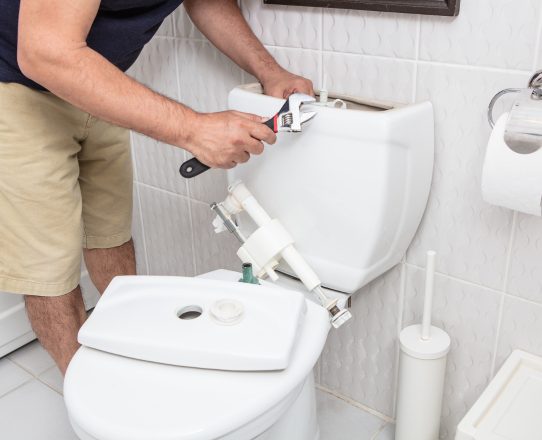
Short answer: A toilet that flushes slowly, gurgles, or keeps backing up after plunging usually isn't a toilet problem at all — it's the first visible sign of a septic tank that's full, a line that's blocked, or a drainfield that's struggling. Catching these three signs early is the difference between a routine pump-out and a drainfield repair.
Sign 1: the toilet flushes slowly or takes multiple flushes to clear
A weak or sluggish flush that used to work fine usually means water isn't draining out of the tank as fast as it should, which points to a full tank, a partially blocked outlet line, or a drainfield that's saturated and pushing back.
If it's happening at multiple fixtures in the house at once — not just one toilet — that's a stronger signal it's the septic system rather than that specific toilet's mechanics.
Sign 2: gurgling sounds coming from the toilet or nearby drains
Gurgling happens when air gets trapped in the line because water isn't flowing freely — usually from a partial clog somewhere between the house and the tank, or from the tank itself being too full to accept more flow.
It's especially common on properties around Linden and Vernon with long runs of pipe between the house and a tank set well back from the structure. The longer that run, the more places a partial blockage can form.
Sign 3: the toilet backs up again shortly after you clear it
A backup that returns within days, even after plunging or snaking, usually means the problem is downstream of the toilet — in the main line, the tank, or the drainfield — not in the toilet trap itself.
This is the sign we take most seriously on a service call, because a recurring backup close to the house often means the tank is full or the drainfield can no longer absorb effluent, both of which need more than a plumber's snake to fix. See our septic repair page for how we sort out which one it is.
When is it the toilet, and when is it the septic system?
If only one toilet in the house is affected and the others drain normally, it's more likely a local clog or a mechanical issue with that fixture.
If it's happening at more than one fixture, especially the lowest drain in the house, or if it correlates with heavy household water use like laundry day, that points to the septic system rather than an isolated toilet problem.
How we diagnose which one it is on a service call
We run water at multiple fixtures at once and watch how the lowest drain in the house responds — if it backs up or gurgles while the tub or washing machine drains, that confirms a downstream problem rather than an issue local to one toilet. From there, a camera run through the main line shows whether it's a blockage, root intrusion, or simply a tank that's full.
This diagnostic step matters because the fix is completely different depending on the answer: a mechanical toilet issue is a simple parts swap, while a downstream septic problem needs a pump-out, a line clearing, or in some cases drainfield work.
What it costs to fix versus what happens if you ignore it
As of 2026, typical range for a pump-out that resolves a full-tank backup runs a few hundred dollars. Ignoring a recurring backup for weeks or months risks pushing solids into the drainfield, turning a routine service call into a repair that costs considerably more and can take longer to schedule, especially with winter ground conditions at 6,000-7,000 feet.
Questions people ask us on the phone
Can heavy monsoon rain make toilet drainage worse?
Is plunging enough to fix a recurring backup?
How urgent is a toilet that won't stop backing up?
Does this mean I need a new septic system?
Why does only the lowest toilet in the house back up first?
Can cold weather affect how a toilet flushes on a septic system?
Related reading: septic repair · septic pumping · emergency septic service
Need this handled instead of read about? See Septic Repair or call (928) 242-2802.