
Blog · Septic Pumping
Three tank problems that mean it's time to call for a clean-out
Published February 18, 2025 · Updated September 20, 2026 · By the Atteberry Industries crew, Show Low, AZ
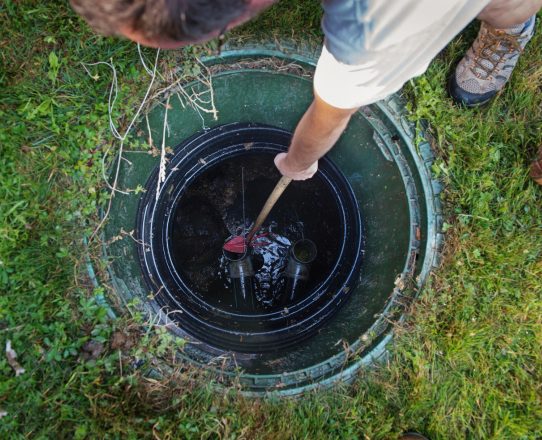
Short answer: Slow-draining fixtures across the house, a sewage smell near the tank or drainfield, and standing water or unusually green grass over the leach field are the three most reliable signs a septic tank needs cleaning. Any one alone can be minor, but two together mean it's time to schedule service before it turns into a backup.
Sign 1: Drains that are slow in more than one fixture
A single slow drain is usually a clog in that fixture's own line. Slow drains in the kitchen sink, the bathtub and the toilet all at once, especially right after you run the washing machine or dishwasher, usually means the tank is full and effluent has nowhere to go.
We see this a lot in older Show Low and Pinetop homes where the tank has never been located or pumped since the house was built — the owner assumes a slow drain is a plumbing issue and snakes the line, when the real problem is downstream in the tank.
Sign 2: Sewage odor near the tank, drainfield or inside the house
A sulfur or sewage smell that shows up outside near the tank lid, over the drainfield, or inside near a floor drain means gases that should be venting through the plumbing stack are instead escaping somewhere they shouldn't. That can mean the tank is overfull, a baffle has failed, or a vent line is blocked.
In dry high-desert air the smell can be faint and easy to write off. If you notice it consistently in the same spot in the yard, that's usually the tank telling you it's past due, not just a bad day for the wind.
Sign 3: Standing water or lush grass over the leach field
A drainfield that's soggy when the rest of the yard is dry, or grass that's noticeably greener over the leach lines, means effluent is surfacing instead of soaking into the soil. That's a late-stage sign — by the time it shows up on the surface, the tank has likely been overdue for a while and the drainfield is taking on more liquid than it can absorb.
During monsoon season (July-September) this sign gets harder to read because everything's wet. Watch for it instead in the dry months, or note if the wet patch persists days after the last rain when the rest of the yard has dried out.
Why waiting past these signs costs more
Once solids reach the outlet side of the tank, they move into the drainfield where they can't be pumped back out. What would have been a routine cleaning turns into a drainfield repair, and on rural White Mountains lots with long dirt driveways, that often means bringing in an excavator, not just a pump truck.
What we actually check when we come out for a cleaning call
We start by locating the lid, measuring sludge and scum depth with a probe, and checking the outlet baffle before we ever start pumping. That tells us whether the tank is just due for its normal service or whether something else is going on, like a cracked baffle or an effluent filter that's clogged solid.
On older Show Low and Pinetop properties where the lid hasn't been dug up in years, locating it can take longer than the pumping itself. If you've got a riser installed, or know where one could go, that saves real time and cost on every future visit.
What a cleaning costs versus what a neglected system costs
As of 2026, typical range for a standard tank cleaning runs a few hundred dollars depending on tank size, depth and how far the truck has to reach down your driveway. Compare that to a drainfield repair, which can run into five figures once excavation and county permitting are factored in, and the math on staying current is easy.
Timing a cleaning around White Mountains seasons
Late spring and fall are the easiest times to get a tank cleaned, since the ground isn't frozen and monsoon runoff hasn't saturated the soil around the lid. If you're seeing any of these three signs heading into winter, get the pump-out done before the ground locks up at 6,000-7,000 feet — digging through frozen dirt for an emergency visit costs more and takes longer than a scheduled one.
Questions people ask us on the phone
Is a bad smell always a sign the septic needs cleaning?
Can I just use additives instead of getting the tank cleaned?
How fast can these signs turn into a backup?
How long does a routine tank cleaning take?
Should I get the tank cleaned even if I don't see any of these signs yet?
Related reading: Septic Tank Cleaning · Septic Pumping · Septic Inspections · Pinetop-Lakeside
Need this handled instead of read about? See Septic Pumping or call (928) 242-2802.