
Blog · Construction Portable Toilets
How many porta potties does your job site actually need
Published January 19, 2026 · Updated September 22, 2026 · By the Atteberry Industries crew, Show Low, AZ
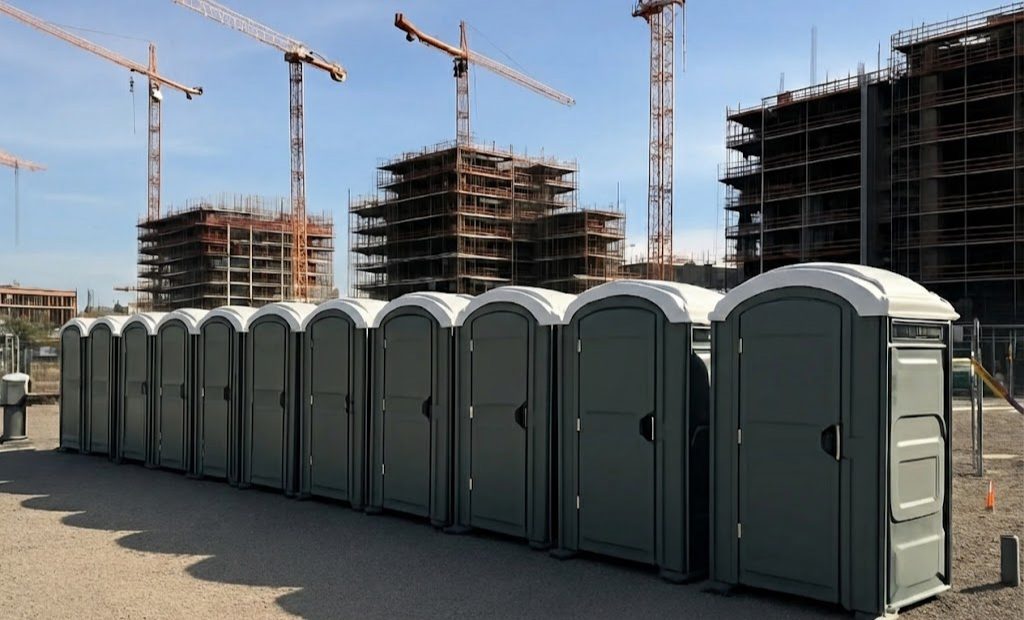
Short answer: Plan one portable toilet per 10 workers on a job site, serviced weekly. That is our standard recommendation, and it keeps a site comfortably within OSHA's sanitation requirements under 29 CFR 1926.51. Count the workers on site at the same time during a shift, not total headcount across the day, and service often enough that units stay usable, not just present.
How many units per worker — and what does OSHA require?
The ratio counts workers on-site concurrently, so a job running two shifts of 15 needs two units sized to 15 workers per shift, not three for 30 combined — though most contractors round up rather than risk a tight call during an inspection.
- Our standard: 1 unit per 10 workers per shift, serviced weekly
- 1-10 workers: 1 unit · 11-20 workers: 2 units · 21-30 workers: 3 units, and so on
- OSHA 1926.51 requires toilets in proportion to crew size; the 1-per-10 standard keeps you comfortably inside it
- Units must be placed within reasonable walking distance of the work area
- Toilets can't drain, discharge or expose contents in a way that creates a health hazard
What happens if a site is out of compliance?
An OSHA inspector who finds too few working toilets for the crew size can issue a citation, and repeat or willful violations carry real fines. Beyond the compliance risk, an undersized count on a busy site means longer lines, workers leaving the site to find a bathroom, and lost productivity — problems that show up well before an inspector ever does.
"Working" is the operative word. A unit that's present but overflowing or out of supplies because service frequency wasn't matched to crew size doesn't satisfy the requirement in any practical sense, even if the unit count on paper looks right.
How often do job-site units need to be serviced?
Standard service is once a week for a typical crew, but sites running more than 10 workers per unit, or a compressed six-day work schedule, often need twice-weekly service to keep pace. We set the schedule based on crew size and site conditions at delivery, and adjust it if the crew grows mid-project — a common situation as a build moves from foundation to framing to finish work with a bigger crew at each stage.
Remote sites on forest roads out past Heber-Overgaard or up toward higher elevation add another variable: winter freeze can slow tank breakdown and complicate access, so we plan routes and timing around road conditions rather than a fixed calendar day.
Where should units be placed on an active site?
Units need to be reasonably close to where crews are actually working, on stable, level, drivable ground our service truck can reach on every visit, not just at delivery. As the site changes — foundation poured, framing up, materials staged — the best location often moves, and we'll relocate units at no extra charge within a normal service visit if the site superintendent flags it early.
On multi-building or spread-out sites, cluster units near high-traffic areas like the break area or material staging rather than spreading them thin across the whole footprint — workers use the closest one regardless of the official assignment.
What does an OSHA citation for insufficient toilets actually look like?
A citation typically follows a walkthrough where an inspector counts units against crew size on site that day, or responds to a worker complaint about access, and finds the ratio doesn't hold up. Under-provision is usually cited as a serious violation because it's a documented, health-related standard, not a paperwork technicality, and the general contractor is typically the party held responsible even when a sub's crew pushed the headcount over the ratio.
In practice, most compliance problems on our jobs aren't from contractors ignoring the rule — they're from a crew growing mid-project without anyone updating the unit count. A site that starts with 8 workers and a single unit can easily be running 35 workers by framing stage, and nobody calls to add units until an inspector or a frustrated crew flags it. Keeping the count matched to actual headcount at each phase is cheaper and simpler than dealing with a citation after the fact.
How does servicing change for winter or remote high-elevation sites?
Freezing overnight temperatures slow the breakdown of waste in the tank and can freeze standing liquid near the top, so winter service in Show Low, Pinetop-Lakeside and higher-elevation areas usually needs a treatment adjustment rather than a different schedule outright — we use a winter-rated deodorizer/treatment mix that resists freezing better than standard summer chemical.
Remote sites reached by forest roads add a second variable on top of cold: snowpack, mud from melt-off, and washboard roads that are fine for a pickup but tough on a loaded service truck. We plan winter routes with extra lead time and sometimes shift a scheduled service day earlier or later around a storm rather than force a truck up a road that isn't safely passable that day — we'd rather call ahead and reschedule than skip a stop, or worse, get a truck stuck on-site.
What are the handwashing requirements alongside toilet units?
OSHA doesn't fold handwashing into the toilet ratio, but it does require employers to provide adequate washing facilities, and most job sites pair a handwashing station with the toilet units for exactly that reason. A freestanding station with foot-pump water and soap, requiring no plumbing or power hookup, satisfies that requirement on most construction sites without adding infrastructure.
Food-handling activity on site, or any crew working with chemicals, coatings or materials that call for washing before breaks or eating, generally needs a station regardless of crew size. We typically place one handwashing station per 1-2 toilet units on active job sites, positioned at the same high-traffic cluster point rather than off on its own.
How should unit count be planned across a multi-phase job?
Crew size on most builds isn't flat — it's light during site prep and foundation, peaks during framing and rough-in when multiple trades overlap, then tapers again through finish work, so the unit count that's right at groundbreaking is often wrong two months later. Planning phase-by-phase from the start, rather than reacting after the crew outgrows the original order, keeps the site compliant without a scramble.
We ask for a rough trade schedule up front on larger jobs — when framing crews, electrical, plumbing and finish trades are each expected on site — so we can pencil in unit additions ahead of the peak rather than waiting for a call once the parking lot is already full of trucks. Superintendents who share that schedule early avoid both the compliance gap and the awkward mid-week emergency add.
How do I set the right service frequency for my crew size?
Start with once-weekly service as the baseline for a standard 5-day crew at one unit per 10 workers, and move to twice-weekly once you're running a bigger crew, a 6-day schedule, or units get heavy midday use from a large workforce concentrated on-site. Undersized service frequency shows up fast as overflow and odor complaints, well before it becomes a compliance issue.
The easiest way to get this right from day one is to tell us crew size and schedule when you book, and to give us a heads-up when headcount changes significantly — we'll adjust the visit frequency at the same rate rather than leaving you to notice the units are falling behind and call in a fix.
Questions people ask us on the phone
Does a small residential job site need a porta potty?
Do subcontractors count toward the worker total?
Can one unit serve multiple small crews working nearby lots?
Does a handwashing station count toward the toilet requirement?
How far in advance should I book units for a new job start?
Who is responsible if OSHA cites a site for too few units?
Do units still need service through the winter?
Related reading: construction portable toilets · ADA portable toilets · handwashing station rentals · commercial septic · portable toilets
Need this handled instead of read about? See Construction Portable Toilets or call (928) 242-2802.